

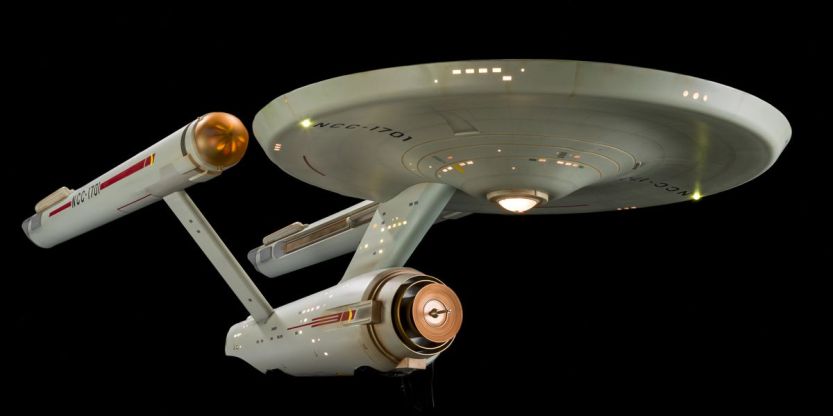
First a confession – I am an “OG” Trekkie. I watched the premier episode on our black and white TV and wouldn’t be anywhere else at 8:00 p.m. on Thursday (Friday for season three).
Of course the Enterprise had to go faster than the speed of light – way faster – in order to get to the next planet and adventure. I know full well from my space geek / astronomy background that the nearest star is Proxima Centarui and that is over 4 light years away, (Alpha Centarui is 5 light years out, and Sirius is 10 light years distant – more or less). A light year is 9.4607 × 10¹² km (or nearly 6 trillion miles).
The Sun to Earth distance is around 9 light minutes. So the Sun could have gone blooey (the most precise technical term for such things), almost ten minutes ago and we would have no idea that it already happened.
The Earth to Moon distance of 1.5 light seconds seems more graspable. But listen to recordings of Apollo astronauts at the Moon conversing with Mission Control in Houston. The conversations move slower – the fastest you could get an answer to a one-word question was three or four seconds – a slow enough feedback loop to notice,
“Space is big. You just won’t believe how vastly, hugely, mind-bogglingly big it is. I mean, you may think it’s a long way down the road to the chemist’s, but that’s just peanuts to space.”
Douglas Adams, The Hitchhiker’s Guide to the Galaxy
As far as we have determined, the best this Universe could do in terms of rapid transit still requires an inconvenient amount of time to get from point A to any interesting point B, especially if said point B happens to be more in the vicinity of a different star than point A.
We live in the suburbs of our galaxy, about 2/3 of the way to the arbitrarily designated edge. Most stars out here are light years apart, except for the many double star systems. The closer to galactic center, the closer the stars are to each other and the more interesting the gravitational and radiation conditions become.
But it’s a long way between the dots in the sky dome from where we stand. Any serial narrative which relies upon a substantial change of venue from segment to segment (chapter to chapter, episode to episode), demands that the process of getting from point A to point B not dominate the story. Police procedurals do not show the lead character driving for an hour in LA traffic to get to a crime scene.
In the same way, space opera has to have a way around the currently understood realities of physics. There have been science fiction writers who have done a good job of describing an interstellar society which travels for many years at high sub-light speeds (See the books about Larry Niven’s Kzini Wars, and Rendezvous with Rama by Arthur C. Clarke, and the recent movie Passengers).
But those societies have invested an incredible amount of resources (and money if they have such a thing) in order to have any form of interstellar travel. Even for the purpose of conquest, that would be a lot of effort just to capture a planet light years from home. That cost alone pretty much blows the “alien invasion” trope out of the water.
(I mean really – if you have the resources to span star systems then there would be a lot easier ways to obtain resources and expand habitation space than dragging your asses for light years and carry on a war of conquest or extermination – think of how expensive that would really be).
Faster Than Light space travel would need to be as cheap and common as ocean and air travel are today. Though the analogy sort of fits, the gap between the U.S. Space Transportation System (aka Space Shuttle) and an interplanetary transport is many orders of magnitude more than the jump from the Wright Brothers to the Space Shuttle. From interplanetary to interstellar is a mind-bogging gap in many aspects, technological, cultural, political and even spiritual.
Not that we won’t bridge that gap, or won’t try to, but it won’t be cheap and it won’t be fast. Nothing regarding space travel is cheap, fast or easy.
Will we finally have the technological base to allow any decent first world country can build their own satellites and launch them upon their own rockets? (Well that seems to be happening as of 2024, but it’s taken since 1957).
A short review of the early days of the U.S. space program reveals a plethora of failures, some dozens of miles in the sky and others on the launch pad. No doubt the Soviet Union had its share of misfires but of course they didn’t talk about them.
Space. Flight. Is. Hard. “Rocket Science” really is “rocket science” (and “rocket engineering”).
It looks easy because we have had decades to sort out the basics and even then things go badly wrong. The current star of space fans, the SpaceX Falcon 9, has blown up on the launch pad during fueling tests and disintegrated in mid-air. FYI, I think Falcon 9 is “dope AF”, and watching videos of the side stages of Falcon 9 Heavy sticking their landings back on shore has yet to get old. Whatever can be said about Elon Musk, his company knows “rocket science”. I wonder what Werner von Braun or Sergei Korolev would think. (I think if those two had worked together and had a half-way decent budget, that we would own the solar system by now).
So what about interstellar travel? Impossible with today’s technology? Probably not but really hard and really, really super expensive – and highly likely to fail.
Why likely to fail? I suppose it could be stated in one word – time. We have yet to build any moderately complex machine which can run continuously for decades without being shut down at least once for maintenance. And of course things wear out, things break or get broken. Any proper interstellar spacecraft would be weighed down carrying replacement parts for damn well everything. If not all replacement parts, then materials and machining to replicate worn out components. That does not come cheap.
Consider something as ordinary as light bulbs. Today we’d be using LED lighting and those should last quite few years. But they eventually will give out and need replacement. So how many spares do you carry for a 50 year trip in a big star ship? Hundreds? A thousand or two?
But not let us forget basic things such as toilet paper – or whatever butt-wiping technology in use. And to stay on the downhill track, what about disposal of various waste materials – tons and tons and for decades. At least someone probably won’t have to dig through someones back yard in order to fix a leaky pipe, but dealing with it under zero gravity might be worse. Floating bubbles of unspeakable nastiness – which has already happened on the International Space Station.
And food – of course there would have to be a closed agricultural ecosystem to keep everyone fed. And they would all be vegetarians by necessity because you can’t easily grow meat (at least not quite yet). Talk about a delicate and possibly fragile thing. It wouldn’t be a matter of waiting for the next harvest unless your “prime directive” is obsessive food hoarding – living in a constant state of being end-of-the-world preppers
And I have barely scratched the surface.
 Shouter to Dead Parrots