

Officer Albert (Einstein) tells us the speed limit is that of light in a vacuum. That’s it – nothing can go faster. And by the way, the faster you go these strange things happen – mass increases, length contracts and time slows down. And of course you can detect none of this – unless you look outside. Should you look at known stars in front or behind you, lo and behold their spectra have changed. The star in front of you has shifted towards blue and the star behind you has shifted towards red.
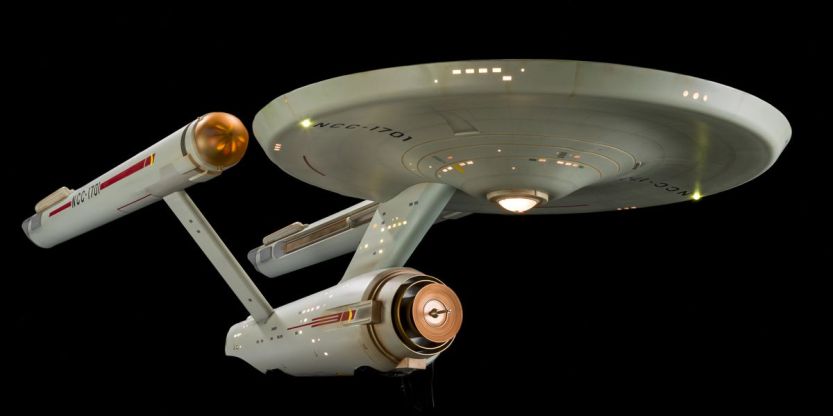
And no, the stars around you will not appear to be whizzing past – Star Trek notwithstanding. They might move fast enough to be noticed month by month, and if you know their distance you could calculate your real speed and therefore some sort of clue of what page everyone else’s calendar may be on.
Of course time dilation helps with the aforementioned issue of longevity for the spacecraft and its occupants. Trip time to Alpha Centauri at 0.1C (18,600 miles per second) would be around 50 years to the external observer. Aboard the star ship, the trip would have been 10% shorter, or about 45 years or so (assuming you move at 0.1c the entire time). Needing the ship to hold together for five less years a good thing, right?
It is unlikely you would get 5 bonus years because you can’t run at full speed the entire trip. Time is needed to accelerate up to 0.1c and eventually decelerate to planetary encounter velocities. Energy is required and the time for it to make changes. It’s like revving your way up a steep hill, and then have to lean on the brakes going down the other equally steep side. You might get to coast a while atop the mesa.
Now let’s talk about energy. How do we move ourselves into and around space? We burn stuff. We have experimented with ion propulsion, but that’s still throwing stuff out the back in order to go forward. How much you go forward is directly related to how much stuff you throw out the back and how fast you throw it. More and faster is better.
More can be accomplished by adding more engines, but faster requires substantial engineering magic. And throwing more stuff requires more stuff to throw – that means propellant. And that means a heavier spaceship which requires pushing more stuff out the back. If this seems like an eternal feedback loop, that is because it is.
We need something a lot more powerful than burning things. In the 1960s when starry-eyed geeks were going on about “Atoms For Peace”, the idea for a nuclear rocket engine came up. It would use a small fission reactor to transform liquid hydrogen to plasma and throw that out the back very fast. Research and some development was done, but someone finally pointed out that you have to put the NERVA stage on a chemical rocket and they have this problem of spontaneously blowing up. So maybe you shouldn’t be sticking a barrel of highly radioactive material on the top of a flying bomb.
That ended the idea of the nuclear rocket, and everyone went back to working on how to burn things hotter and throw them faster. Doing that takes years of research and development and a considerable amount of money. It doesn’t matter if you have the rest of the rocket ready to go, without engines you have a big strangely shaped grain silo.
How do we possibly go interstellar? Or interplanetary at anything resembling decent speed? Not going to happen by burning stuff.
This is where the science part of science fiction really kicks in. New things need to exist – hydrogen fusion, matter / anti-matter annihilation, nanoscopic black holes, dark matter, and many other hand-wave driven power sources. In the police procedural, the officer doesn’t lecture about how an internal combustion engine works, he just cranks it up and goes.
But when an entire world is presented with technology totally unlike what we have today, inquiring minds demand to know what and how. And since said technology does not exist, or even the theoretical foundation of said technology does not exist, you can make stuff up. Make it sound good and it will be good enough for a lot of people.
So we have to make something up for interstellar travel. Once again, some science fiction writers really thought about how to do this and remain more or less within the laws of physics. The Mote in God’s Eye by Larry Niven and Jerry Pournelle does this very well, IMNHO.
Typically assume hydrogen fusion. Does away with messy and dangerous radioactive materials and if designed properly, can be turned off with the close of a valve. That can make nice plasma out of easy to handle material and throw it out the back at a nice high speed.
Now there’s the question of supplying the material to be thrown out fast by the fusion engine. How much to reach Proxima Centauri? Millions of kilograms? Billions? Trillions? How big does the exponent on the power of ten need to be? And where does that material come from?
To call the notion of hauling zillions of mass units of propellants from the Earth’s surface problematic is to understate the problem by many orders of magnitude. We would need water which isn’t at the bottom of a rather steep gravity well – and a lot of it. And the energy required to break apart water molecules to free the hydrogen. Deuterium (hydrogen with one added neutron) is better fusion fuel, but is the natural abundance of deuterium is 0.0156% . That means processing a lot of water to find those very few heavy water molecules. This is one of the ways to get “heavy water”, which is a good neutron sink and so was a strategic material to Nazi Germany and the Allies.
About the star ship itself – it will have to be BIG. The largest object ever built by humanity. Considering the amount of propellant required, the vehicle would be maybe a mile or more in length and have billions of kilograms of mass – without fuel. Add the supplies for the journey, proper equipment for setting up a viable colony upon arrival, spare parts, auxiliary spacecraft and a plethora of other things not detailed here – and the dead weight of the ship explodes.
And where does the raw materials for the star ship come from? Again, we need sources which are not at the bottom of a steep gravitational well. Once these sources are secured, there remains the problem of turning rocks into a space ship. If that sounds hard, well that’s because it is.
Let’s review where we are now as concerns interstellar travel.
- The trip will take decades at best.
- The star ship must last for decades under constant operation.
- The passengers and crew will need to be fed, doctored, etc unless they can ride it out in some kind of hibernation which we have no idea how to do.
- May require billions of liters / kilograms of propellant – which will have to be extracted out of water from somewhere besides Earth.
- Requires power sources we do not have. So far nuclear fusion reactors are nowhere near break-even for power in / power out and the times of active fusion is in the milliseconds.
- Some sort of artificial gravity will be required – possibly meaning large rotation sections of the ship, or being under nearly constant acceleration / deceleration – which the ship would have to be doing anyway.
- It will be holy ***** expensive – in the trillions of whatever currency is being used, in time and resources for research / development.
And since I’ve already passed the TL;DR threshold, I’ll leave it at that.
 Shouter to Dead Parrots